
Armature Winding Machine: Technology Behind Efficient Motor Manufacturing
Electric motors form the backbone of the modern industry. From household appliances and power tools to electric vehicles and industrial automation systems, motors rely on precisely engineered components to function efficiently. One of the most critical parts of these motors is the armature, which converts electrical energy into mechanical motion or vice versa.
To produce armatures with consistent quality and performance, manufacturers rely on a specialized piece of equipment known as an armature winding machine. This machine is designed to wind insulated copper wire around the slots of an armature core with high precision and repeatability.
In this article, we explore how an armature winding machine works, the different types available, and how the technology supports armature winding in DC machines and AC machines across various industries.
What is Armature Winding in DC Machine?
To understand the importance of winding machines, it is essential to first answer a common question: what is armature winding in DC machine systems?
In a DC motor or generator, the armature winding refers to the insulated copper conductors placed in slots on the armature core. These windings carry electrical current and interact with the magnetic field generated by field windings or permanent magnets.
The result of this electromagnetic interaction is:
- Mechanical rotation in motors
- Electrical energy generation in generators
In armature winding in DC machine designs, the windings are connected to a commutator. The commutator ensures that the current direction in the coils remains properly synchronized with the rotating magnetic field, allowing the machine to produce continuous torque.
Because these windings directly influence motor efficiency, torque, and reliability, they must be manufactured with high accuracy. This is where an armature coil winding machine becomes essential.
What is an Armature Winding Machine?
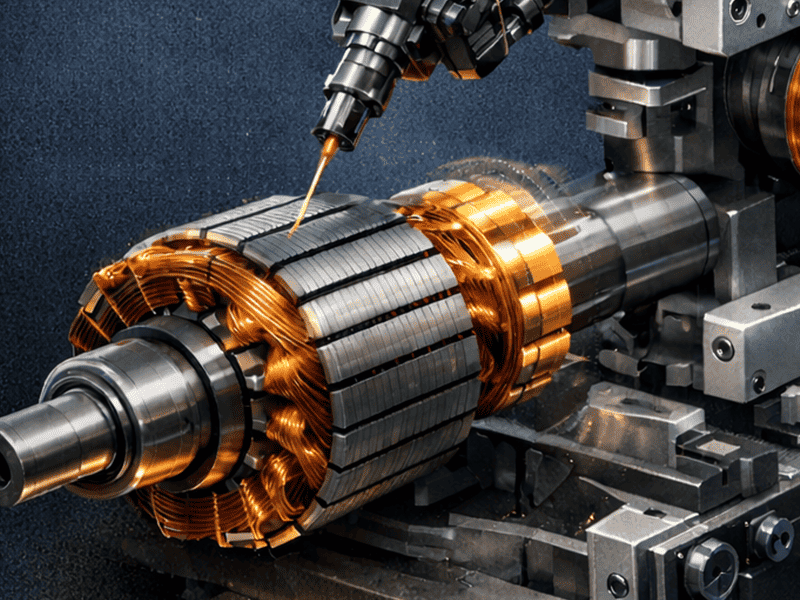
An armature winding machine is specialized equipment used to wind copper wire around the slots of an armature core in a controlled and consistent manner.
The machine automates or assists with the winding process, ensuring that each coil is placed correctly according to the motor’s design specifications.
Key functions of an armature winding machine include:
- Controlling wire tension during winding
- Ensuring precise placement of coils within armature slots
- Maintaining uniform winding patterns
- Increasing production speed and efficiency
Without automated winding machines, manufacturers would struggle to maintain consistent coil quality, especially in high-volume motor production.
Types of Armature Winding Machines
Depending on production requirements, armature winding machines are available in several configurations. The two most common types are automatic armature winding machines and manual armature winding machines.
Automatic Armature Winding Machine
An automatic armature winding machine is designed for large-scale motor manufacturing where precision and speed are critical.
These machines operate using advanced control systems such as PLC or CNC programming, allowing manufacturers to produce complex winding patterns with minimal human intervention.
Typical features include:
- Automated wire feeding systems
- Programmable winding patterns
- Automatic slot indexing
- Precision tension control
- High-speed winding operations
The biggest advantage of an automatic armature winding machine is its ability to produce large quantities of armatures with consistent quality.
Industries that commonly use these machines include:
- Automotive motor manufacturing
- Electric vehicle motor production
- Industrial motor manufacturing
- Appliance motor production
- Power tool motor manufacturing
Automation not only improves productivity but also reduces errors in the winding process.
Manual Armature Winding Machine
A manual armature winding machine is typically used in smaller workshops, repair centers, or low-volume production environments.
Unlike automated machines, manual systems require an operator to guide and control the winding process.
Common characteristics include:
- Hand-controlled winding operation
- Lower production speed
- Simple mechanical design
- Lower initial investment cost
Manual armature winding machines are often used for:
- Motor repair and maintenance
- Small batch manufacturing
- Prototyping new motor designs
- Educational and training purposes
Although they cannot match the speed of automated machines, they remain valuable tools in many specialized applications.
Armature Coil Winding Machine: Key Components
A modern armature coil winding machine includes several mechanical and electronic components designed to ensure accurate winding.
Wire Feeding System
The wire feeding system guides the copper wire from the spool to the armature core while maintaining consistent tension. Proper wire tension is critical to prevent damage to insulation and maintain coil integrity.
Armature Indexing Mechanism
This mechanism rotates and positions the armature so that the winding machine can place coils precisely into each slot.
Accurate indexing ensures that the winding pattern follows the motor’s electrical design.
Tension Control System
Maintaining consistent wire tension is essential for producing uniform coils. Advanced machines use electronic tension control systems to regulate wire tension automatically.
Control System
Modern machines are often equipped with digital control panels or PLC-based systems. These allow operators to program parameters such as:
- Number of turns per coil
- Winding speed
- Coil pitch
- Slot configuration
This programmability allows the same machine to be used for multiple motor designs.
DC Machine Armature Winding: Importance in Motor Performance
In a DC machine armature winding, the arrangement of coils determines how effectively the machine converts electrical energy into mechanical energy.
Two common types of armature windings used in DC machines include:
Lap winding
- Used for high-current, low-voltage machines
- Multiple parallel current paths
Wave winding
- Used for high-voltage machines
- Fewer parallel paths
An armature winding machine ensures that these winding patterns are implemented accurately according to the design specifications.
Any inconsistency in winding can lead to issues such as:
- Uneven torque
- Increased heat generation
- Reduced motor efficiency
- Premature motor failure
This is why precision winding equipment is essential in motor production.
Armature Winding in AC Machines
While the concept of armature winding is most associated with DC machines, armature winding in AC machines is also important.
In AC machines such as alternators and synchronous motors, the armature winding is typically located in the stator rather than the rotor.
In these machines:
- The armature winding carries the output current
- The rotor produces the rotating magnetic field
Although the physical configuration differs from DC machines, the fundamental purpose of winding remains the same: to enable electromagnetic interaction that produces electrical energy or mechanical motion.
High-precision winding machines are also used in the manufacturing of AC motor coils to ensure balanced electrical characteristics and optimal performance.
Applications of Armature Winding Machines
Armature winding machines are widely used across industries involved in electric motor manufacturing and repair.
Some of the most common applications include:
Electric Vehicle Motors
The rapid growth of electric mobility has increased the demand for high-precision motor manufacturing, making automated winding machines essential.
Industrial Motors
Manufacturing plants rely on motors for conveyors, pumps, compressors, and automation systems.
Household Appliances
Many appliances such as washing machines, mixers, and fans use motors that require accurate wound armatures.
Power Tools
Electric drills, grinders, and saws rely on compact motors with precisely wound armatures.
Generator Manufacturing
Armature winding machines are also used in generator production to ensure efficient power generation.
Benefits of Using an Armature Winding Machine
Using an armature winding machine offers several advantages over manual winding methods.
Improved Precision
Machines ensure accurate coil placement and consistent winding patterns, which improve motor performance.
Higher Productivity
Automated machines significantly increase production speed, allowing manufacturers to produce large volumes of armatures.
Reduced Human Error
Automation minimizes mistakes in coil placement, winding tension, and turn count.
Better Motor Efficiency
Proper winding ensures balanced electromagnetic fields, improving motor efficiency and lifespan.
Scalability
Manufacturers can easily scale production by upgrading to automatic winding machines.
Conclusion
The armature winding machine plays a vital role in modern electric motor manufacturing. By enabling precise and efficient winding of copper coils, these machines ensure that motors operate reliably and efficiently across a wide range of applications.
Whether it is a manual armature winding machine used in motor repair workshops or a fully automatic armature winding machine used in high-volume manufacturing, the technology remains essential for producing high-quality electrical machines.
As industries continue to move toward electrification and automation, the demand for advanced armature coil winding machines will continue to grow, making them a cornerstone of modern motor production.
Frequently Asked Questions
1. What is armature winding in DC machine applications?
It refers to the process of winding insulated copper conductors around the rotating armature to enable electromagnetic interaction and torque generation.
2. Can an armature winding machine handle different motor sizes?
Yes, most modern armature winding machines feature adjustable tooling and fixtures that can support different armature core diameters and motor configurations.
3. Is manual operation still relevant today?
Yes. A manual armature winding machine is still useful for repair applications, prototyping, and low-volume motor production.
4. How long does an armature winding machine typically last?
With proper maintenance and regular servicing, an armature winding machine can operate efficiently for many years in industrial environments.
5. Does automation reduce labour costs in motor manufacturing?
Yes. An automatic armature winding machine reduces operator dependency, increases winding accuracy, and significantly improves production throughput.
6. Can armature winding machines support AC machine applications?
Yes. Many modern machines can be adapted for armature winding in AC machines as well as DC motor configurations.