
Automatic Coil Winding Machine: Precision Solutions for Modern Coil Manufacturing
Introduction
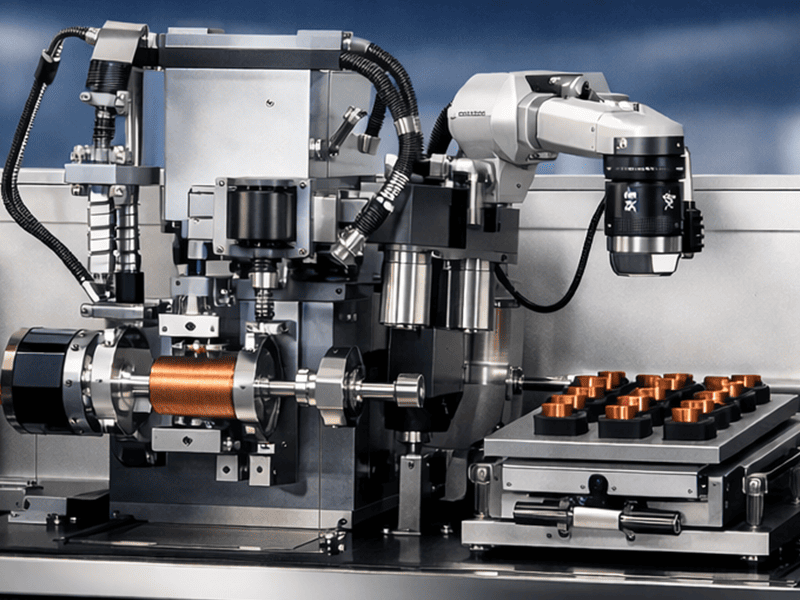
The automatic coil winding machine plays a central role in modern electrical component manufacturing. Designed to wind copper or aluminum wire around a core with high accuracy, these machines improve productivity while maintaining the quality required for transformer coils, motor coils, and specialized magnetic components.
These machines wind copper or aluminum wire around a core or bobbin to produce coils used in transformers, electric motors, inductors, and other electromagnetic components. By automating the winding process, manufacturers can improve production speed, ensure uniform coil quality, and reduce manual errors.
Modern coil winding machines are now critical in power electronics, automotive manufacturing, and industrial equipment production for sustaining high productivity and meeting demanding performance standards.
Understanding the Role of Automatic Coil Winding Machines
An automatic coil winding machine controls the entire winding process through programmed systems that manage wire tension, winding speed, layering, and turn count. This level of automation ensures that coils are produced with precise specifications, which is essential for electrical performance and reliability.
Compared to manual winding, a coil winding machine automatic system offers several advantages:
- Unmatched Precision: Computer Numerical Control (CNC) ensures every turn is exact, maintaining consistent wire tension to prevent deformation.
- High Throughput: Systems today can handle “load-wind-unload” cycles autonomously, often producing double the output of a semi-automatic coil winding machine.
- Reduced Waste: Advanced sensors detect wire breaks or tension inconsistencies in real-time, drastically lowering copper scrap rates.
These machines are widely used as coil winders in manufacturing environments that require high levels of accuracy and scalability.
Understanding the Automation Spectrum
Choosing the right equipment depends on your production volume and the complexity of your coils.
| Feature | Semi-Automatic Coil Winding Machines | Fully Automatic Coil Winding Machine |
| Operator Role | Manual loading/unloading and lead fixing. | Minimal supervision; autonomous cycling. |
| Best For | Prototyping, small batches, or diverse coil shapes. | High-volume, standardized production runs. |
| Cost | Lower initial capital investment. | Higher upfront cost but lower long-term labor expenses. |
| Flexibility | High; easy to adjust for custom jobs. | Specialized in speed and repeatability. |
Types of Automatic Coil Winding Machines
Different coil applications require different winding solutions. Manufacturers typically select machines based on coil size, complexity, and production volume.
Fully Automatic Coil Winding Machine
A fully automatic coil winding machine performs the winding process with minimal operator involvement. These machines automatically manage wire feeding, tension control, layering, and turn counting.
Fully automated systems are ideal for high-volume production environments where efficiency and consistency are essential. Many large-scale facilities use a fully automated coil winder for efficiency when producing components for motors, transformers, and electronic devices.
Semi-Automatic Coil Winding Machine
A semi-automatic coil winding machine combines automation with operator control. While the machine performs the winding operation, the operator may load coil forms, adjust parameters, or manage production changes.
Many manufacturers rely on semi-automatic coil winding machines for smaller production runs, specialized components, or applications where flexibility is required. These machines provide a balance between automation and manual control.
Automatic coil winding machines: Applications Across Industries
The versatility of automatic coil winding machines extends across industries; from heavy electrical equipment to compact electronic devices. A few prominent sectors include:
Power and Energy
The automatic transformer coil winding machine is essential in manufacturing power and distribution transformers. Automation ensures precise layering and consistent insulation spacing, which directly affects efficiency and thermal stability in electrical grids.
Electric Motors and Generators
The automatic motor coil winding machine is widely used in producing stators and rotors. Controlled winding tension and pattern precision result in superior torque output, reduced noise, and extended motor lifespan.
Medical Devices
Miniature precision coils used in medical sensors, imaging systems, and micro-motors benefit from automated winding that can handle extremely fine wire gauges.
Automotive and EV Components
As electric mobility accelerates, automotive manufacturers rely on fully automatic coil winding machines to produce consistent coils for traction motors, onboard chargers, and EV power electronics.
Selecting the Right Coil Winding Equipment: Key Considerations
Investing in an automatic coil winding machine requires thoughtful evaluation of your production needs, design specifications, and long-term scalability. The right equipment can dramatically boost output quality and manufacturing efficiency, while the wrong choice can limit flexibility or raise maintenance costs.
Here are several essential factors to consider before making your investment:
Coil Design and Specifications
The dimensions, winding pattern, and wire gauge determine the machinery’s required torque, spindle speed, and traverse accuracy.
Production Volume and Workflow
High-throughput operations benefit from fully automatic coil winding machines, while R&D or pilot lines may find semi-automatic coil winding machines more adaptable.
Automation and Control Capabilities
Look for programmable logic controllers (PLCs), user-friendly interfaces, and memory storage for different winding programs to ensure easy setup and repeatable precision.
Integration and Connectivity
Check compatibility with existing inspection systems, data acquisition tools, and manufacturing execution systems (MES) for seamless process monitoring and quality assurance.
Maintenance and Support
Reliable technical assistance, readily available spare parts, and responsive service are critical for maximizing uptime and machine lifespan.
By aligning your choice of coil winding equipment with your performance targets and production goals, you can achieve optimum efficiency, precision, and scalability across every stage of manufacturing.
The Competitive Edge of Automation in Modern Manufacturing
In an increasingly competitive manufacturing landscape, adopting an automatic coil winding machine isn’t just a technological upgrade; it’s a strategic growth move.
Automation translates to measurable business gains: higher output, lower overheads, and consistent product quality that strengthens your reputation.
By streamlining coil production, companies can:
- Boost productivity with faster cycle times and minimal manual involvement.
- Reduce costs by cutting wire wastage, labor dependency, and rework.
- Enhance precision and reliability, ensuring every coil meets performance standards effortlessly.
- Accelerate scalability, moving from semi-automatic coil winding machines to fully automated systems as demand grows.
- Gain market advantage through improved turnaround times and superior consistency—vital factors in high-stakes industries like energy, automotive, and electronics.
Ultimately, automation isn’t just about machines; it’s about growth efficiency. The automatic coil winding machine empowers your business to deliver more, faster, and better, positioning you ahead in a results-driven market.
Conclusion
The automatic coil winding machine has become an essential solution for manufacturers seeking higher precision, faster production cycles, and consistent coil quality. Whether used for motors, transformers, or specialized electromagnetic components, modern coil winding systems enable manufacturers to meet the increasing demands of today’s electrical and electronics industries.
From semi-automatic coil winding machines designed for flexible production to fully automatic coil winding machines built for high-volume manufacturing, selecting the right equipment plays a critical role in optimizing performance and efficiency.
Synthesis Winding Technologies Pvt Ltd specializes in advanced coil winding solutions designed to support modern manufacturing needs. With expertise in developing high-performance winding equipment; including automatic motor coil winding machines, automatic transformer coil winding machines, and customized winding solutions for specialized applications, Synthesis delivers reliable and precision-engineered systems for industries worldwide.
By combining innovation, engineering excellence, and industry expertise, Synthesis Winding Technologies Pvt Ltd continues to help manufacturers improve productivity, enhance coil quality, and streamline their production processes with cutting-edge automatic coil winding machine technology.
Ready to automate your coil production? Talk to our experts to discover the automatic coil winding machine configuration that fits your goals and budget.
Frequently Asked Questions
Q: Is automation worth it for smaller manufacturers?
A: Yes. Compact automatic coil winding machines bring big‑factory precision to small production floors, improving consistency and reducing labor costs from day one.
Q: Can one system handle multiple coil types?
A: Absolutely. With modular tooling and programmable controls, a single setup can produce motor, transformer, or specialty coils with minimal changeover time.
Q: How quickly can my team learn to operate it?
A: Most teams are production‑ready within just a few days. User‑friendly interfaces make setup and training fast, so you start seeing results right away.
Q: When will I see a return on investment?
A: Many customers see ROI in less than a year, sometimes within six months, thanks to higher throughput and lower rework rates.
Q: Can I upgrade later as production grows?
A: You can. Start with a semi-automatic coil winding machine and scale to a fully automated solution anytime, without replacing your existing investment.